 |
|
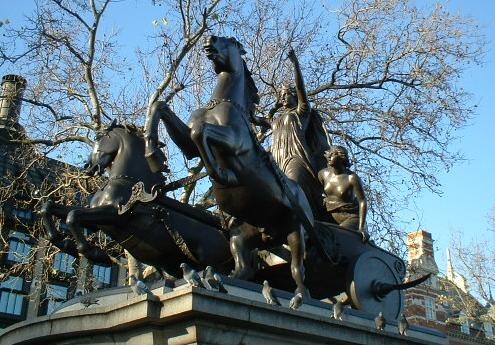
Statue of Boadicea in London |
Hope of Israel Ministries (Ecclesia of YEHOVAH):
1st Century Britain and the Gospel of the Messiah!
During the middle of the 1st century A.D., the people of Britain were inflamed by the heavy-handed Roman administration and its policies of excess. Following the public flogging of the Iceni queen and the rape of her daughters, and the horrible massacre of a religious center in Wales, the island of Britain exploded and forces were set in motion that almost drove the Romans from the land. During this troubled time and its aftermath, the Good News of the Kingdom of YEHOVAH God was powerfully preached to both the British and the Romans. Illustrious figures in the Church of YEHOVAH God, such as Paul, Simon the Zelote, Aristobulus and Peter, strode the highways and byways of Britain converting many to the Faith and bringing a ray of light to an otherwise troubled land. This is the inspiring story of their evangelism in the far-flung reaches of the Roman Empire. |
by John D. Keyser
Following the defeat of the British chieftain Caractacus in 52 A.D. by the legions of Rome, his cousin Arviragus quickly reorganized the Silurian forces and struck back at the Romans with a fury seldom witnessed before.
Prince of the noble Silures of Britain, who lived mainly in the counties of Monmouth, Brecon and Glamorgan, Arviragus was the son of King Cunobelinus -- the Cymbeline of Shakespeare's writings. Together with his cousin Caractacus, he represented the Royal Silurian dynasty, the most powerful warrior kingdom in the isles of Britain. From this warrior king the Tudor kings and queens of England had their descent.
The Roman commander Ostorius Scapula was in charge of the Roman armies of Britain at the time; but his legions had become greatly demoralized by defeat after defeat and the terrible savagery of the British onslaughts. In the following year (53 A.D.) Scapula suffered a staggering defeat at Caervelin, near Caerleon in Wales. Discouraged and broken in health from the years of frustrating warfare, he petitioned Emperor Nero to be relieved of his command and return to Rome. Nero accepted Scapula's resignation and he was immediately replaced by Aulus Didius -- also known as Didius Gallus. This is recorded by the Roman historian Tacitus in his Annals (12:40). Didius went on to found the city of Cardiff, which is still known by the Welsh as Caer Dydd -- "The Castle of Didius."
One of Didius' first acts upon arriving in Britain was to depose Cartismandua, Queen of the Brigantes, whom he thoroughly distrusted. Because of her treacherous betrayal of her cousin Caractacus to the Romans, she was held in contempt by both the Romans and the British.
Didius had no more luck than his predecessor in dealing with Arviragus on the field of battle. He suffered repulse and defeat in rapid succession. After a brief command he was replaced with Veranius -- who fared no better. The indefatigable Arviragus drove the Roman forces behind the Plautian wall of fortresses and bottled up the hapless Veranius at Veralam (St. Albans). Circumstances in the field had become so bad for the Roman legions that, in desperation, Nero ordered huge reinforcements to Britain, under the relieving command of Suetonius Paulinus -- one of the ablest tacticians in the Roman army. He force-marched the Second Augusta Legions and the famous Ninth, Fourteenth, and Twentieth Legions to Britain and, on arrival, found he was also unequal to the occasion. Disaster followed disaster as the victorious British drove the enemy before them -- asking no quarter and giving none.
The historian Tacitus bitterly expresses the mood at Rome which required their most capable generals and finest legions to combat the "barbarous" British at the extreme of the empire. He bemoans:
In Britain, after the captivity of Caradoc [Caractacus], the Romans were repeatedly defeated and put to rout by the single state of the Silures alone. (Annals, 12:38-39).
Even the clemency shown to the captive Caractacus at Rome by Emperor Claudius did not mollify the Silurian troops. Men, women and priests took to the field to avenge and halt the continued persecution of the Roman administration in Britain. Tacitus ruefully remarks: "The race of the Silures are not to be changed by clemency or severity." (Annals, 2:24)
The hatred against Rome was so great that Arviragus outlawed the accepting or circulating of Roman coin in Britain -- making it a capital offense to do so! This was because, according to the Roman interpretation, the accepting or circulating of coin in a province inferred the right of levying tribute. As a result of Arviragus' ruling, no coins of the emperors between Claudius and Hadrian have been found in Britain.
Without mercy the British fought pitched battles, stormed forts and Roman encampments and put Roman settlements to the torch. The record reads: "The plains and streets ran with Roman blood."
The more the Romans suffered defeat the more excessive were the reprisals. In frustration Suetonius Paulinus ordered a scorched-earth policy to destroy everything in their path and particularly to eliminate the seats of Druidic and Christian learning. According to Tacitus, this horrible campaign raged at its worst from 59 to 62 A.D.
This led to the horrible Menai massacre in Wales. Orders were issued from Rome to Suetonius Paulinus to exterminate, at any cost, the chief seat of Druidism among the Cymry, or Western Britons. By forced marches along the Wyddelian road, Suetonius reached the banks of the Menai strait. It was a complete surprise. Crossing the strait, opposite the present seat of the Marquis of Anglesey (Plas Newydd), the Romans entered the community under the pretext of peace. With concealed weapons, the Roman soldiers suddenly attacked the defenseless inhabitants and butchered thousands of unsuspecting priests and priestesses -- along with a multitude of men, women and children. Both the aged and infants were hewn down without mercy.
The Rise of Boudicea
In 60 A.D. the greedy Roman Prefect, Catus Decianus, broke the Claudian Treaty with the Iceni tribe on a false pretext formulated by the Roman philosopher Seneca. Seneca, who at that time held great influence with Emperor Nero, was probably better known as the wealthiest man in Rome -- a man who obtained his vast fortune by deceit and promoting usurious loans. It appears he advanced a huge sum of money to Prasutagus, the king of the Iceni, on the security of the tribe's public buildings. When Prasutagus died, Seneca conspired with Decianus to call in the loan and disregard the valid claims of the late king's estate.
Isabel Hill Elder, in her book Celt, Druid and Culdee, writes of this conspiracy --
Seneca, the usurious millionaire philosopher, advanced to the Iceni, on the security of their public buildings, a sum of money -- about two million pounds sterling in modern currency, at ruinous rates; this loan, suddenly and violently called in, was the indirect cause of the Boadicean war. It was a disgrace for a Roman to lend to a Roman for interest; they were permitted, however, to lend to a foreigner.
The territories of the Iceni were rich in lead-mines, some of which were known to have been worked in times of even greater antiquity; the Romans seized these mines soon after their arrival in Britain, thus cutting off an important source of the wealth of the Iceni people and obliging them to borrow money from Seneca for the maintenance of their state. (1973: The Covenant Publishing Co., p. 40)
The immensely wealthy Prasutagus, realizing that in the event of his death the Romans would treat his queen, Boadicea, and his two daughters, with contempt, left half of his fortune to the Emperor Nero, hoping to secure for his family a measure of protection. The Roman Prefect, however, disregarded this and needed no second invitation to satiate his greed from the pillage and plunder that would follow.
This act of treachery was made all the more simple for Decianus by reason of an existing Peace Treaty made between Rome, the Iceni and the Coraniaid. Unfortunately, this political agreement enabled the Romans to enjoy freedom of movement in the domain of these two British clans. This privilege gave Decianus the opportunity to take the British by surprise. He struck with such violence and brutality that even the Roman Senate and writers were appalled.
Decianus and Seneca sacked the British palaces and public buildings -- removing everything of value. They stripped the Iceni nobles of their estates and personal wealth formerly guaranteed to them by the Claudian Pact. To add to the infamy of this act, Tacitus records that licentiousness ran wild. The two young daughters of Queen Boadicea, widow of Prasutagus, were publicly raped by the Romans in an act that was as much political as it was humiliating. Since Boadicea's daughters were in direct line to her throne and posed a danger to Roman rule, it was thought by the Roman officials that deflowering the girls would make them less attractive to noblemen -- thus reducing their power. It was customary for Roman executioners to publicly deflower young virgins (so the gods would not be offended) then either throw them from a cliff or strangle them. In this case the Romans believed it to be more humiliating to merely rape the girls and have Boudicea severely flogged.
The Menai massacre followed closely on the heels of this outrage. These combined events so infuriated the British that a frenzy of anger swept the length and breadth of the island. The Roman writers graphically reported that the Roman administration and legions alike were stunned by the avalanche of British reaction. In fright the Romans confined their forces within their own encampments.
The Roman accounts are replete with the profound gloom in which their forces were plunged, and by the omens which foreshadowed the coming disasters. Writes R. W. Morgan:
Portent on portent is recorded. At Colchester the statue of Victory, like that of Dagon at Joppa, fell backward and was shattered to fragments. A Pythoness, agitated, like Cassandra on the eve of the fall of Troy, with the insuppressible spirit of divination, caused the streets to re-echo with the cry -- 'Death is at hand.' In the senate-house the British war cry, uttered by invisible tongues, terrified and dispersed the councillors. The theatres resounded with the shocks and groans of a field of battle. In the waters of the Thames appeared the mirage of a Roman colony subverted and in ruins. The channel between Dover and Calais ran at high tide with blood. On the tide receding, the sands revealed, in long lines, the impressions of files of bodies laid out for burial. The Menai massacre had, in fact, terrified the consciences of its perpetrators. (St. Paul in Britain. 1984: Artisan Sales, CA., p. 95)
|
|
|
Statue of Boadicea in London |
Remarks the Encyclopedia Britannica:
The proud, fierce queen and her people rose, and not alone. With them rose half Britain, enraged, for other causes, at Roman rule. Roman taxation and conscription lay heavy on the province; in addition, the Roman government had just revoked financial concessions made a few years earlier, and L. Annaeus Seneca, who combined the parts of a moralist and a money-lender, had abruptly recalled large loans made from his private wealth to British chiefs. A favourable chance for revolt was provided by the absence of the governor-general, Suetonius Paulinus, and most of his troops in north Wales and Anglesey. All south-east Britain joined the movement. (1943 edition. Vol. 3, p. 759.)
Notes author George F. Jowett --
Despite the fact that the Iceni and the Coraniaid were branded as traitors for deserting Caractacus during the Claudian campaign, these atrocities brought the British clans together in a solid phalanx. The British Queen Boadicea, inflamed by the personal indignities perpetrated upon her daughters and her people, rose in militant defiance to avenge the insults. Her warriors swarmed around her eager for the fray. She was to lead them into battle with a devastating offensive that has caused her name to flame throughout British history as the finest embodiment of Britannia. (The Drama of the Lost Disciples. Covenant Publishing Co: 1980, p. 151.)
Boudicea sent Venusius, the Pendragon of the Iceni, to Arviragus offering to place the combined forces of the Iceni and the Coraniaid under his command. Whether he accepted or not is unrecorded; but we do know that the Pendragon Venusius led the two warrior tribes as second-in-command, with Boudicea as Commander-in-Chief. Leading her warriors personally into battle, Boudicea was a born warrior chieftainess -- undoubtedly the greatest warrior Queen in all history.
Queen of the Celts
For years she was called Bunduica or Voadicia; then for a while she became Bonducca and later still Boudica or Boudicea. The early spellings of her name were a result of poor transcriptions from medieval manuscripts and incorrect versions of Tacitus -- whose account of her story was not discovered until the 16th century. However, the spelling of her name means "Victory" (hence "Victoria") and was acquired as a result of her valor in earlier military campaigns. Always despising the Romans, she now hated them with a bitterness that hungered for revenge. In appearance she was a striking figure; and the Roman writer Dion Cassius records:
Boudicea ascended the general's tribunal; her stature exceeded the ordinary height of women; her appearance itself carried terror; her aspect was calm and collected, but her voice became deep and pitiless. Her hair falling in long golden tresses as low as her hips, was collected round her forehead by a golden coronet; she wore a tartan dress fitting closely to the bosom, but below the waist expanding in loose folds as a gown; over it was a chlamys, or military cloak. In her hand she bore a spear. (Xiphilinus Excepta, p. 176)
Such is the compelling portrait of the majestic Boudicea, as she stood surrounded by the 120,000 warriors who had responded to her cry for vengeance. To them she delivered an address that has come down to us as one of the truly remarkable speeches in British history. Dion Cassius records it thus --
I appeal to thee a woman. I rule not, like Nitocris, over beasts of burden, as are the effeminate nations of the East, nor like Semiramis, over tradesmen and traffickers, nor like the man-woman Nero, over slaves and eunuchs -- such is the precious knowledge these foreigners introduce among us -- but I rule over Britons, little versed in craft and diplomacy, but born and trained in the game of war, men who, in the cause of liberty stake down their lives, the lives of their wives and children, their lands and property. Queen of such a race, I implore thine aid for freedom, for victory over enemies infamous for the wantonness of the wrongs they inflict, for their perversion of justice, for their contempt of religion, for their insatiable greed; a people that revel in unmanly pleasures, whose affections are more to be dreaded and abhorred than their enmity. Never let a foreigner bear rule over me or these my countrymen; never let slavery reign in this island. Be thou forever O goddess of mankind and victory, sovereign and Queen in Britain. (ibid.)
The Boudicean War
Having exhorted her troops with this remarkable speech, the famous Boadicean War began in 60 A.D. With her two daughters at her side and fiercely inspiring her warriors, Boadicea led her armies from one devastating victory to another. The scythes on the wheels of the British war chariots slashed deep into the Roman lines. Colchester was the first city to fall. Writes P. B. Clayton:
Maddened by what they had experienced, the whole Iceni tribe and people...broke through Grimsdyke, which runs past Newmarket. A gallant handful of Rome's London troops vainly endeavoured to arrest their passage. Having brushed aside these, Boudicca led the vengeance of her tribe on Colchester.
The temple, reinforced by Roman veterans, held out for two days -- then succumbed to the fury of the British. The Ninth Legion, under Petilius Cerealis, was slaughtered at Coggeshall while marching to the rescue from the heights where Lincoln now stands. Swamped by sheer numbers, the legionnaires went down fighting. Cerealis and a few horsemen were the only ones to escape alive. The Roman headquarters at Verulam was torched and its defenders cut to pieces. It seemed as though nothing could stop the terrible onslaught of the British Queen. The Roman populace fled in terror on news of her armed approach; and Tacitus states that one Roman Legion that dared to stand ground was wiped out to the last man. (Annals, 14:32)
By this time Boadicea's forces had swelled to the enormous number of 230,000 -- clearly indicating that more than the two original clans were supporting her cause. It is more than likely that the Silures, under Arviragus, were participating in this concerted action, since the war had extended into their territory. History does record that the powerful Trinobantes -- the warlike clan with whom Julius Caesar signed the Peace Pact of September 26, 54 B.C., had cast their lot with the British Queen.
Writes George F. Jowett:
Now with at least four of the most powerful warrior clans in Britain massed together under the one standard of baneful vengeance to the number of more than a quarter of a million, there is no need for wonder why the Romans were swept ruthlessly before them. Never before had the British been so deeply wounded and angered by the violation of their native privileges; their religious institutions and personal dignity. The desecration charged them with superhuman determination to avenge. (The Drama of the Lost Disciples, pp. 153-154)
Tacitus reports that more than 80,000 Roman soldiers perished in these bloody battles. Catus Decianus, whose conspiracy with the philosopher Seneca launched Boadicea's vengeful campaign, was so terrified by the violence of the conflict and the terrible carnage he witnessed that he fled into Gaul (France).
History records that the greatest single carnage followed in the wake of the attack on the city of London. At that time it was a populous city, the trade center in Britain for international commerce. As such it was filled with Roman merchants and was protected by a powerful Roman garrison. Nothing was further from their thoughts than that the city was in imminent danger of destruction. Notes P. B. Clayton --
Since London had disdained defensive foresight, and Rome itself was very far away, the news of the rebellion of Boudicca with the Iceni Tribe upon the march, spreading through Norfolk and to Cambridgeshire like hungry locusts short of ways and means, did not at first appear to be important; and hesitation had its fatal sway. The crisis would not wait for peacemakers, although the Roman Government in London stationed in their new stronghold, Leadenhall, were prepared to recognize that an unfortunate mistake had been made in the policy which caused Boudicca to pass the fiery sign throughout her people. Her husband had been head of the whole tribe, and in a certain sense was recognized throughout the whole of Norfolk as their Chief. (Harvest Thanksgiving Service, Church of All Hallows-by-the-Tower. October 1, 1954.)
The assault and destruction of the city is one of the most appalling war records one can possibly read. It was nothing less than a massacre and shows how intense was the British fury. According to some historians Suetonius Paulinus, Commander-in-Chief of the Roman forces, was so terrified by the British onslaught that he fled the scene with a handful of his troops. However, this is hardly conceivable. The chroniclers record that the battle for London was waged savagely for several days -- indicating that the British encountered organized military resistance. It is more probable that Paulinus made good his escape when he saw the battle was lost. He left the destruction of the city, its inhabitants and such Legionnaires that remained, to the sword of the pitiless troops under Boadicea.
Tacitus tells us that the British put 40,000 of the Roman defenders of London and its inhabitants to the sword -- then they razed the city to the ground.
Next in line was the important city of Verulam -- now St. Albans. Boadicea leveled the city, driving the enemy before her. The inhabitants of Regnum and Rutupium fled before her armies arrived. It has been said that the destruction of lives on both sides was so great that the burning towns and cities were quenched by their blood. Boadicea and her armies swept westward in an effort to intercept Paulinus. Dion Cassius reports that many battles were fought "with the heavy balance of disaster borne upon the Romans."
The Unexpected Climax
The climax to the victorious Boadicean War ended in a most unpredictable manner at Flintshire in 62 A.D. -- where the modern town of Newmarket now stands. Paulinus, who seems to have rejoined his army, engaged the British in a savage conflict that was fought from dawn to dusk -- with the battle swaying in favor of one side then the other. Writes Jowett --
As dusk set in a section of the British army, led by Boadicea, was separated from the main body. Believing herself trapped and fearing capture (even though the record states the British forces had reorganized, preparatory to a final major assault), rather than fall into the hands of the despoilers and the rapine she knew would follow, the valorous Queen Boadicea, in a last gesture of defiance, committed suicide on the field of battle. As the tragic news swept through the ranks of both sides, it is recorded that Briton and Roman alike were stunned with the calamity of this extraordinary climax. Fighting immediately ceased with each side withdrawing into their own encampment with unbidden consent. The death of this great British queen settled like a pall over all. The woman who had terrified the Romans in life awed them in death. A great sadness descended upon her people. And the Romans, quick to seize an opportunity, took advantage of the situation to come to peace terms with the Iceni. (The Drama of the Lost Disciples, p. 155)
Under the terms of this new Peace Treaty with the Romans, all the confiscated wealth of the Iceni royalty, the nobles and the people was restored. The estates were returned to the surviving members of the royal household and to the nobility with all their original privileges. Seneca's perfidious transaction was terminated and an heavy indemnity paid to the Iceni. Dion Cassius wrote: "Every peace with the British was a signature of defeat."
The royal Boudicea, majestic in appearance, rich in eloquence, dauntless in war and endowed with a military genius which outmatched the ablest strategists of Rome for two years, was now no more than a glorious memory. The Romans recorded that her funeral rites were the most magnificent ever bestowed on a monarch. They gazed in wonder on its splendor -- awed and silenced in both shame and fear. Her unhappy death, though spectacular, was an incomparable sacrifice for the preservation of the ancient British freedoms for which she stood.
The scene of the final battle and its tragedy has been commemorated over the centuries by place names known to this day as "Cop Paulinus," "Hill of Arrows," "Hill of Carnage," "Hollow of No Quarter," "Hollow of Woe," "Hollow of Execution," "Field of the Tribunal," and "Knoll of the Melee." On the scene there still exists a monolith known as "The Stone of Lamentation" -- described as the spot where Boudicea took her life. On the road to Caerwys was "The Stone of the Grave of Boudicea," since moved to Downing.
The war against the Romans did not cease with her death. The Roman Peace Treaty made with the Iceni had no effect on the other British clans. Tacitus writes that her tragic death did not halt the punitive spirit and determination of the Britons in the north and the west. Under the leadership of Arviragus, Venusius, and a gallant new Pendragon, Galgacus, hostilities continued against the Romans.
The Arrival of Simon Zelotes
To all this calamity Joseph of Arimathea and his small band of workers at Glastonbury were sorrowful spectators. Mention is made in the Magna Tabula Glastonia (cited by Ussher) of Joseph traveling to Gaul in 60 A.D. -- at the beginning of the Boudicean War -- and returning to Britain with another band of recruits. In this band was Simon Zelotes, one of the original twelve disciples of the Messiah. Before leaving Gaul the apostle Philip consecrated Joseph and his new band of co-workers -- probably because the inclusion of Simon Zelotes indicated an important missionary effort.
This was the second journey to Britain for Simon Zelotes and, according to the records, his last. Both Cardinal Baronius (the church historian who was also appointed Vatican Librarian in 1596) and Hippolytus, place Simon's first arrival in Britain in the year 44 A.D. -- during the Claudian War. Evidently his stay was short at this time and he returned to the continent.
Nicephorus, Patriarch of Constantinople and Byzantine historian (758-829 A.D.) writes --
Simon born in Cana of Galilee who for his fervent affection for his Master and great zeal that he showed by all means to the Gospel, was surnamed Zelotes, having received the Holy Ghost from above, travelled through Egypt, and Africa, then through Mauretania and all Lybia, preaching the Gospel. And the same doctrine he taught to the Occidental Sea, AND THE ISLES CALLED BRITANNIAE.
Otto Hophan, in his book The Apostles, says: "A third general opinion, which later Greek commentators in particular followed placed the scenes of Simon's Apostolic labors in N.W. Africa, Mauretania and even Britain." (p.285)
Simon arrived in Britain during the first year of the Boudicean War (60 A.D.) when the whole island was convulsed in a deep, burning anger against the Romans. Tacitus states that from 59 to 62 A.D. the brutalities of war were at their worst. Atrocities occurred on both sides but the Romans, it seems, carried their viciousness to such an extent that even Rome was shocked. With this in mind we can readily see that any Christian evangelizing outside the British shield maintained by Arviragus and his forces would be fraught with imminent danger. At all times the disciples of the Messiah in Britain were oblivious to danger, but when the pressure became too great they invariably fled the land until matters quieted down.
In 44 A.D. a Claudian Edict expelled the leaders of the Church of YEHOVAH God in Rome; and many of them sought sanctuary in Britain. This was the year Simon first visited Britain. However, he did not come from Rome but from Gaul -- where he had been assisting the apostle Philip. Simon was also directly associated with Joseph of Arimathea's group at Glastonbury during both of his visits to Britain. Whether he came from Rome or from Jerusalem made quite a difference to Arviragus and the British in their acceptance of him .
It is recorded that Simon was unusually bold and fearless -- as his name implies. In spite of the turmoil seething through Britain during the Boudicean War, Simon openly defied the Edict of Paulinus, and the brutal Catus Decianus, to destroy anything and anyone Christian.
Simon decided to conduct his work in the eastern part of the Island. This section of Britain was the most sparsely inhabited by the native Britons and consequently more heavily populated by the Romans. He was far beyond the strong protective shield of the Silurian arms in the south and the powerful northern Yorkshire Celts. In this dangerous territory Simon Zelotes was definitely on his own. Writes George F. Jowett:
Undeterred, with infinite courage, he began preaching the Christian Gospel right in the heart of the Roman domain. His fiery sermons brought him speedily to the attention of Catus Decianus, but not before he had sown the seed of Christ in the hearts of Britons and many Romans who, despite the unremitting hatred of Decianus for all that was Christian, held the secret of the truth locked in their hearts. (Drama of The Lost Disciples, p. 159.)
The Martyrdom of Simon
The evangelizing mission of Simon was short-lived. He was finally arrested under the orders of Catus Decianus. As usual his trial was a mockery. He was condemned to death and was crucified by the Romans at Caistor, Lincolnshire, and there buried circa May 10, 61 A.D.
The day of Simon's martyrdom is officially celebrated by the eastern and western church (Catholic) on May 10th and so recorded in the Greek Menology, which has proven to be highly accurate. Cardinal Baronius, in his Annales Ecclesiastici, gives the same date in describing the martyrdom and burial of Simon Zelotes in Britain.
Dorotheus, Bishop of Tyre (300 A.D.) writes in his work Synopsis de Apostol:
Simon Zelotes traversed all Mauretania, and the region of the Africans, preaching Christ. He was at last crucified, slain and buried in Britain.
Writing in 1685, Dorman Newman gave the following account of Simon Zelotes:
He is said to have diverted his journey towards Egypt, Cyrene, Africa, Martania, and Lybia. Nor could the coldness of the climate benumb his zeal or hinder him from shipping himself over into the Western Islands, yea even to Britain itself. Here he is said to have preached and wrought many miracles, and after infinite troubles and difficulties which he underwent, suffered martyrdom for the faith of Christ, being crucified by the infidels and buried among them. (The Lives and the Deaths of the Holy Apostles, p. 94)
Unknown to most, the remains of Simon Zelotes, and a host of other early disciples of the Messiah, are buried in England, creating the saying known the world over, "Britain, the most hallowed ground on earth."
The year before the Boudicean War broke out, and the two years of its course, are the darkest, most bloodstained years in British history. Yet, at the same time, they are epic years in the annals of the early Church of YEHOVAH God in Britain -- resplendent with noble sacrifice and heroic deeds which outmatched the terror and stark tragedy those years contained. To this notable period the martyrdom of Simon Zelotes added a glimmer of light to an otherwise dark and dreadful time.
Of interest to Americans is the fact that Simon Zelotes perished near to the ancestral home of Abraham Lincoln -- the great Christian American President. His ancestors migrated from England in the first waves of English colonists to settle in Virginia. Eighteen hundred years after the martyrdom of Simon in the land of the Lincolns, Abraham Lincoln became a martyr for his humane Christian principles in America -- the new land of the descendants of the Israelites of old.
Aristobulus -- The 1st Martyr
There are some who believe that Simon Zelotes was the first Christian martyr in the province of Britain. Actually, of the elect he was the second. Aristobulus, brother of Barnabas and father-in-law of the apostle Peter, was the first to be martyred on British soil.
There is very considerable body of evidence that shows Aristobulus traveled to Britain and died there. Hippolytus (born circa 160 A.D.), the most learned member of the Roman Church of that period, who was probably bishop of the Greeks in Rome during the episcopates of Zephyrinus and Callixtus, mentions Aristobulus as "Bishop of the Britons." Hippolytus had heard the lectures of Irenaeus, who was born 30 years before him and who was a pupil of Polycarp, the beloved friend and student of the apostle John.
In the Martyrologies of the Greek Church, the Greek Menology for March 15 reads:
Aristobulus was one of the seventy disciples, and a follower of St. Paul the Apostle, along with whom he preached the Gospel to the whole world, and ministered to him. He was chosen by St. Paul to be the missionary bishop to the land of Britain, inhabited by a very warlike and fierce race. By them he was often scourged, and repeatedly dragged as a criminal through their towns, yet he converted many of them to Christianity. He was there martyred after he had built churches and ordained deacons and priests for the island.
Haleca, bishop of Augusta, says in the Halecae Fragmenta in Martyr that "the memory of many martyrs is celebrated by the Britons, especially that of St. Aristobulus, one of the seventy disciples."
Dortheus, bishop of Tyre in 303 A.D. (or whoever wrote the tract attributed to him) says: "Aristobulus, whom Paul saluted, writing to the Romans, was Bishop of Britain." (Synopsis de Apostol., Synops. 23, "Aristobulus")
Ado, archbishop of Vienne (800-874 A.D.), states in the Adonis Martyrologia for March 17 --
Natal day of Aristobulus, Bishop of Britain, brother of St. Barnabas the apostle, by whom he was ordained Bishop. He was sent to Britain, where after preaching the truth of Christ, and forming a church, he received martyrdom.
Echoes Achau Saint Prydain: "These came with Bran the Blessed from Rome to Britain -- Arwystli Hen [Aristobulus the Aged], Ilid [Joseph of Arimathea], Cyndaf [chief, or head], man of Israel, Maw or Mawan, son of Cyndaf [Josephes -- Joseph of Arimathea's son]." (Genealogies of the Saints of Britain)
Here, then, is very early Eastern, Roman, Greek and British church testimony for the presence of Aristobulus in Britain.
Aristobulus was ostensibly Paul's forerunner in Britain -- sent by the apostle to the Gentiles to prepare the way for his own particular mission, which was to follow later and to be separate from Joseph of Arimathea's work at Avalon (Glastonbury). In the early stages Aristobulus was associated with Joseph but never attached to the group at Glastonbury. He labored in the part of Britain now known as Wales; and the district of Arwystli [named after Aristobulus] in Montgomeryshire on the Severn river commemorates one of the areas he labored in.
Aristobulus also became the supervisor of the Church of YEHOVAH God at Llan-ilid, with Bran remaining as the apostle to Siluria at Llandaff.
Unfortunately, the aged Aristobulus was to meet with a tragic end within a year of his return to Britain with his royal companion Bran.
Unlike Aristobulus' mission, which came directly from Rome, Joseph of Arimathea and his companions had come directly from Jerusalem. It had no contact with Rome. The wealthy Joseph also had the advantage of being well known to the British through his former interests in the tin mining of Cornwall and Devon. When he arrived at Glastonbury he was so well received by the British that he was considered one of them. On the other hand, the deep-rooted hatred of the British for Rome -- and anything associated with it -- persisted with an unrelenting passion. As far as the British were concerned, anything tinged with the Roman stigma was cause for grave suspicion.
Bran, who was the father of the much-feared and respected Caractacus, wrote in his journals that he and his companions were hard put to induce the British to accept anyone or anything that came from Rome. It was only their love for Bran and their proud loyalty to Caractacus that made them willing to meet half-way the delegation of YEHOVAH God's servants from Rome. Aristobulus, however, was well respected by the Silurians since he had originally (on his first visit) come to them from Jerusalem, through Spain, and was known to be loved by Joseph of Arimathea and his co-workers at Glastonbury.
Problems occurred when Aristobulus, in his zeal to preach the Good News of the Kingdom of YEHOVAH God, traveled far beyond the territory of the Silures and the protection they offered. He began preaching in the lands of the British Ordovices, whose hatred for the Romans was bitter and black. Notes George F. Jowett --
This blinded them to the facts, and he was unknown to them. Aware of the many ruses the Romans had instigated against the Britons in order to trick them into submission, they lumped the presence of the aged elder brother of Barnabas with some form of Roman political treachery, in which religion played an hypercritical part of the scheme. They rose and slew him, given as the year A.D. 58 or A.D. 59, according to the present reckoning. (The Drama of the Lost Disciples, p. 187)
Aristobulus was evidently the only follower of the Messiah martyred by the British during this time.
Paul Sets Out for Spain
Paul's founding of the first organized Church of YEHOVAH God at Rome culminated in his special mission to Britain. Before he had gone to Rome he had sent, as his personal representative, Aristobulus, the father-in-law of the apostle Peter. As mentioned earlier, Aristobulus was ostensibly Paul's forerunner in Britain -- sent to prepare the way for his own particular mission, which was to follow later. On the death of Aristobulus, Ilid, "a man of Israel," who had traveled with Bran and Aristobulus to Cambria, took charge until Paul arrived.
The loss of Aristobulus was a terrible blow to Paul. He had sent his salutations to his friends at Rome -- including "the household of Aristobulus."
In 61 A.D., following his house arrest in Rome, Paul headed for Spain. The route of his trip to Spain is found in a Greek manuscript discovered in the archives of Constantinople. Known as the Sonnini Manuscript after C. S. Sonnini who translated the document in 1801, its text begins at the point where the book of Acts finishes, and reads as follows:
And Paul, full of the blessings of Christ, and abounding in the spirit, departed out of Rome, determining to go into Spain, for he had a long time purposed to journey thitherward, and was minded also to go from thence into Britain. For he had heard in Phoenicia that certain of the children of Israel, about the time of the Assyrian captivity, had escaped by sea to "the isles afar off," as spoken by the prophet, and called by the Romans Britain. And the Lord commanded the gospel to be preached far hence to the Gentiles [Israelites living amongst the Gentiles], and the lost sheep of the House of Israel. And no man hindered Paul; for he testified boldly of Jesus before the tribunes [a lot of the Romans were actually descended from Israel -- especially the upper class] and among the people; and he took with him certain of the brethren which abode with him at Rome, and they took shipping at Ostium, and having the winds fair were brought safely into a haven of Spain.
In Romans 15:24 and 28 it was Paul's stated intention to visit Spain after leaving Rome; and not only Spanish tradition but also the testimonies of numerous early writers confirm that he did. The Epistle of Clement and the Muratori Fragment both assert that Paul did indeed visit Spain. Eusebius mentions, as Sir William Ramsay also points out, a gap in the life of Paul between his release from house arrest in Rome in 61 A.D. and his death in 67 A.D. During this time he went somewhere and, as we shall see, that certainly included Spain and Britain.
William Steuart McBirnie, in The Search for the Twelve Apostles, mentions that "one great authoritative biography, 'The Life and Epistles of the Apostle Paul,' by Conybeare and Howson, which is as widely accepted a biography of St. Paul as any, emphatically asserts that St. Paul did indeed go to Spain, spending at least two years there." (p. 679)
The "haven of Spain" mentioned in the Sonnini Manuscript was, without a doubt, the port of Gades or Cadiz. It is known that a colony of Israelite and Phoenician peoples was established here in very ancient times. More than likely, this was the port of Tarshish (Spain) that Jonah the prophet headed for centuries earlier when he tried to escape from YEHOVAH God.
E Guest, in Origines Celticao, states --
Cadiz was the commercial centre of Western Europe, and was no doubt the place St. Paul had in mind when, writing to the Romans, he spoke of his "journey into Spain."
His journey into Spain is mentioned, as if it were a well-known historical fact by Jerome, Chrysostom and Theodoret...There was ample opportunity for St. Paul to visit Cadiz, and to found a church there, during the six years that elapsed between his first and second imprisonment at Rome; and among his Spanish converts there could hardly fail to be some who traded with the British Isles. (p. 121)
Ivor C. Fletcher notes that "there was nothing in the least bit unusual about a sea voyage between Rome and Cadiz during the first century." (The Incredible History of God's True Church, p. 82) J. B. Lightfoot, in The Apostolic Fathers, comments that "the commercial and passenger traffic with Gades was intimate and constant." (vol. 2, p.31)
The commission given by the Messiah to Paul, as mentioned in Acts 9:15, was to take the gospel to "the Gentiles [Israelites living amongst the Gentiles and considering themselves to be Gentiles], and kings, and the children of Israel." When Paul left Rome for Spain the first two parts of this task had already been completed. The inhabitants of Cadiz and the surrounding countryside were mainly of Israelite and Phoenician stock who had settled the region centuries earlier when the Phoenicians were at their height of power. The Israelite element represented a small part of the "lost ten tribes" of Israel.
In circa 200 A.D., Tertullian mentions that "the extremities of Spain, the various parts of Gaul, the regions of Britain which have never been penetrated by the Roman armies, have received the religion of Christ." (Def. Fidei, p. 179)
Across to Britain!
The Sonnini Manuscript continues the story of Paul's mission:
And they departed out of Spain, and Paul and his company finding a ship in America sailing into Britain, they went therein, and passing along the South coast they reached a port called Raphinus.
It is interesting to note the mention of a place called "America" in the manuscript. The fact that there was another "America" back in the time of Paul is understood by a number of historians. In the marginal notes on page 7 of Bede's Ecclesiastical History of England this "America" is identified as follows: "In Caesar's time, the whole district lying along the north-western coast of Gaul, afterwards narrowed down to modern Brittany." The fact that the United States is known as "America" to most people today is no coincidence -- the "America" of old was peopled by descendants of the Israelites as is the "America" of today! A number of other writers affirm that the gospel entered Britain by way of Brittany or "America."
The exact location of Raphinus, mentioned in the manuscript, is uncertain. "Some identify this as the Roman name of Sandwich in Kent. A port in this vicinity is known to have been used by the Romans during the first century A.D. An old house is said to have existed at Sandwich until Saxon times which was known as 'The House of the Apostles.'" (The Incredible History of God's True Church, p. 84)
Another strong possibility, however, is found in Our Neglected Heritage, by Gladys Taylor:
As to the place of St. Paul's arrival in Britain, we have a little local history given by a Miss Hargrove in an old history of the Isle of Wight. She speaks of St. Paul arriving "with several other Christians, some of whom had been in personal contact with our blessed Lord Himself. He [Paul] landed at Bonefon in the Isle of Wight. The exact spot is now Sandown Bay, which was a mouth of the harbour of Brading....He passed to the mainland from Rhydd, the ferry or passage now called Ryde, to Aber Deo, the port of God, or Godsport" -- Gosport!
Nearby Paulsgrove, north of Portsmouth, is said to be named because Paul visited there. George F. Jowett writes that "it is claimed that Paul landed at what is now a suburb of the great naval port of Portsmouth, known over the ages and to present times as 'Paul's Grove.' From here he evidently made his way into Cambria..." (The Drama of the Lost Disciples, p. 192)
Lionel Smithett Lewis was aware of this tradition and wrote, in his book St. Joseph of Arimathea at Glastonbury, the following --
In the south of England also there lingers a tradition of St. Paul's landing. Close to busy modern Portsmouth stands what was the village of Porchester, at the far end of the harbour. As its name denotes, it was a Roman Fort, and the foundations of the castle are still there. It was the chief port also of this part of the country, and was called Portus Adurnis. The modern Portsmouth was then a mud flat, at the entrance to this busy flourishing port. Locally the traditions of this busy port remain, and there is a further tradition that St. Paul landed to the east of the present Porchester at a spot still called Paul's Grove or Paul Grove. Until lately there was a grove of ancient trees running down to the water's edge, but the trees are now nearly gone. A main road runs through what was the grove, and an oil depot occupies part of it! A few old trees on the far side of the road still linger on private ground attached to an old house, sole tangible witness of the ancient tradition, and possibly of the great Apostle there. But still the name Paul's Grove lingers as a suburb of Portsmouth. (1988: Cambridge, pp. 79-80.)
The landing of Paul at "Bonefon" on the Isle of Wight seems to conflict with the verse in the Sonnini Manuscript that refers to Paul landing at "Raphinus" -- which an accompanying note renders as "Sandwich." There could be some confusion of names here. The Sonnini Manuscript is in Greek, which means the names were translated. Both Sandown [Bay] and Sandwich mean "sandy soil"; and both places were important Roman ports. If the ship carrying Paul sailed from America (Brittany) as the Sonnini Manuscript states, the Isle of Wight would provide the nearest port.
Roman London
Returning to the manuscript we read --
Now when it was noised abroad that the apostle had landed on their coast, great multitudes of the inhabitants met him, and they treated Paul courteously, and he entered in at the east gate of their city [London], and lodged in the house of an Hebrew and one of his own nation. And on the morrow he came and stood upon Mount Lud; and the people thronged at the gate, and assembled in the Broadway, and he preached Christ unto them, and many believed the word and the testimony of Jesus...And it came to pass that certain of the Druids came unto Paul privately, and showed by their rites and ceremonies they were descended from the Jews which escaped from bondage in the land of Egypt, and the apostle believed these things, and he gave them the kiss of peace. And Paul abode in his lodgings three months, confirming in the faith and preaching Christ continually.
The "Mount Lud" mentioned in the Sonnini Manuscript can be identified with the modern-day Ludgate Hill, located within the City of London. Notes Ivor Fletcher: "A variety of objects dating to the first century have been unearthed in this area showing that it was a spot used by Romans and the local Britons during Paul's day." (The Incredible History of God's True Church, p. 85)
Geoffrey of Monmouth records that Lud-Gate was constructed by King Lud in 66 B.C. Holinshed confirms this by writing,
Lludd began to reign in 72 B.C., seventeen years before the Romans came. He made a strong wall of lime and stone and fortified it with divers fair towers, and in the west part of the same wall he erected a strong gate, which he commanded to be called after his name "Ludgate," and so unto this day, it is called Ludgate....He caused buildings to be made between London stone and Ludgate and builded for himself not far from the said gate a fair palace which is the Bishop of London's palace, besides Paules at this day... (London Through the Ages, p. 13)
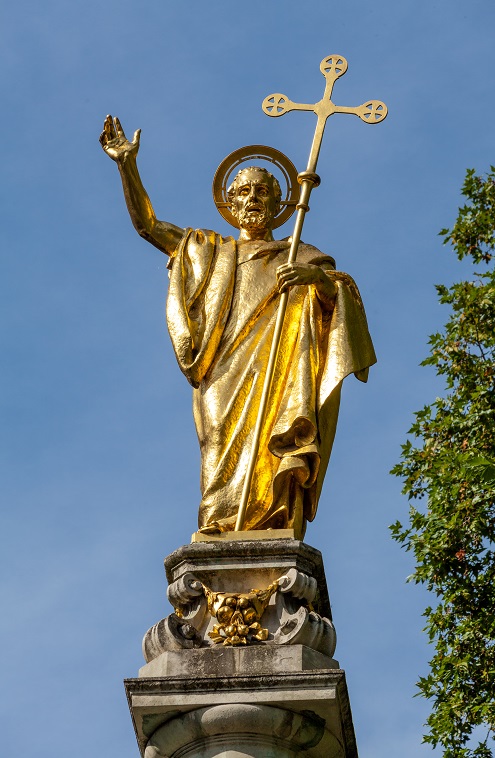
The famous St. Paul's Cathedral is erected on the site; and the ancient St. Paul's Cross may well mark the very spot where Paul stood as he preached the Good News of the Kingdom of YEHOVAH God to the British.
Another spot in London where Paul is said to have preached is the Llandin, or Parliament Hill. Parliament Hill is the largest and most imposing of the four prehistoric "Gorsedds" found in the metropolis. Standing on a spur of the Northern Heights in an amphitheater of wooded hills half way between Hampstead and Highgate, the "Sacred Eminence" of the Druids retains some of its original dignity as a "high-place of worship."
E. O. Gordon, in his landmark work on the city of London, adds the following --
Parliament Hill carries on its Keltic traditions as a place of assembly to this day. On the northeast slope is a stone monument on which an inscription states that here public speaking is allowed. The numerous assemblies, religious and political, which from time immemorial have been held either on the mound itself or on "Parliament Fields" at its base, is an interesting survival of a national custom.
The Llandin has been called the "Areopagus" of Britain, from the tradition that St. Paul preached from the summit. On this account the Apostle became the Patron Saint of London, and his emblem, the sword of martyrdom, incorporated in the arms of the City..." (Prehistoric London. 1985: Thousand Oaks, CA., p. 110)
 |
|
Statue of the Apostle Paul in London |
According to another tradition, Paul also preached at a spot called Gospel Oak -- which is now a part of Hampstead Heath.
Writes Ivor Fletcher: "A charter given by King Canute in 1030 would also seem to confirm the story of Paul's visit. It reads: 'I, Canut, king of the English, grant lands for the enlargement of the Monastery of the blessed Apostle Paul, teacher of the peoples, and situation in the City of London.'"
Fletcher continues --
It can hardly be denied that the former Mount Lud did become the site of a national place of worship. One only has to witness a state occasion such as the Queen's Silver Jubilee in 1977 to realize that the representatives of several nations do come to worship on this spot. This great cathedral does indeed bear Paul's name and in a sense testifies of his visit and preaching. (The Incredible History of God's True Church, p. 86)
The exact date for this visit of Paul to London cannot be determined, but it had to be somewhere between the time he was released from house arrest at Rome in 61 A.D. and the destruction of London in 62 A.D. by Boadicea.
Other Areas
During his stay in London, it is quite possible he traveled to other areas of the land. There is a tradition he made his way into Cambria (Siluria) and spent some time at Bangor. Here a famous abbey was built -- the doctrine and administration of which was known as Pauli Regula ("The Rule of Paul"). Over each of its four gates was inscribed his motto: "If a man will not work, neither let him eat." The abbots of Bangor regarded themselves as successors of Paul, and each was specially elected from those of royal descent.
R. W. Morgan notes that,
there are six years of St. Paul's life to be accounted for, between his liberation from his first imprisonment and his martyrdom at Aquae Salviae in the Ostian Road, near Rome. Part certainly, the greater part perhaps, of this period, was spent in Britain -- in Siluria or Cambria, beyond the bounds of the Roman Empire; and hence the silence of the Greek and Latin writers upon it. (St. Paul in Britain, p. 118)
There is an ancient manuscript in Merton College, Oxford, which is supposed to contain a series of letters between the apostle Paul and Seneca, and which has more than one allusion to Paul's residence in Siluria.
Samuel Lysons, in his book Claudia and Pudens, claims that Paul visited Gloucester and preached there. This is quite possible because Gloucester was founded by Emperor Claudius and stood at the border between Siluria and Roman-occupied Britain. There have been more coins of Claudius discovered here than at almost any other town in Britain. The political and military significance of the city was such during the reigns of Claudius and Nero that Paul was sure to have heard of it.
The Triads of Paul the Apostle
There is extant a collection of writings in the ancient British tongue that have been handed down from ancient times. Known as The Triads of Paul the Apostle, these may be strong evidence of Paul's visit to Britain. Explains Ivor Fletcher --
A Triad was the traditional style of writing and public speaking in Britain in ancient times and probably could be defined as "three main points."
Ministers and other speakers in the British Churches of God to this day often arrange their sermons or other lectures around three main points. Perhaps Paul, wishing to be "all things to all men" used the traditional style of public speaking in Britain, and that form has been handed down through the generations since that time. (The Incredible History of God's True Church, p. 95)
While these Triads are not found "totidem verbis" (either whole or fragmentally) in his epistles, the morality inculcated is quite in line with the rest of his teachings in the New Testament. Notes R. W. Morgan: "The evangelical simplicity of these precepts, contrasting so forcibly with monkish and mediaeval inventions and superstitions, favours the traditional acceptance of their Pauline origin. Their preservation is due to the Cor of Ilid. (St. Paul in Britain, p. 119)
Nowhere else are these Triads recorded, and nowhere else is the term "Triads" used outside Britain. This also favors acceptance of their Pauline origin.
The Sum Total of it All
Clement (see Philippians 4:3), being one of the original band that dwelt at Glastonbury with Joseph of Arimathea, knew Paul intimately long before he followed Linus as the leader of the Church of YEHOVAH God at Rome. With great eloquence Clement sums up the magnitude of the achievements of the apostle to the Gentiles --
To leave the examples of antiquity, and to come to the most recent, let us take the noble examples of our own times...Let us place before our eyes the good Apostle, Peter, through unjust odium, underwent not one or two, but many sufferings; and having undergone his martyrdom, he went to the place of glory to which he was entitled. Paul, also, having seven times worn chains, and been hunted and stoned, received the prize of such endurance. For he was the herald of the Gospel in the West as well as in the East, and enjoyed the illustrious reputation of the faith in teaching the whole world to be righteous. And after he had been in the extremity of the West, he suffered martyrdom before the sovereigns of mankind; and thus delivered from this world, he went to his holy place, the most brilliant example of steadfastness that we possess.
The "extremity of the West" was a term used to denote the province of Britain.
Capellus, in his History of the Apostles, writes: "I know scarcely of one author from the time of the Fathers downward who does not maintain that St. Paul, after his liberation, preached in every country of the West, in Europe, Britain included."
Theodoret, of the 4th century A.D., writes: "St. Paul brought salvation to the Isles in the ocean."
Ventanius, Patriarch of Jerusalem in the 6th century, speaks very definitely of Paul's visit and evangelism in Britain, as does Irenaeus (125-189 A.D.); Tertullian (122-166 A.D.); Origen (185-254 A.D.); Mello (256 A.D.); Eusebius (315 A.D.); Athanasius (353 A.D.) and many other writers of church history.
If further confirmation is needed, it can be found in the records of the Roman, Eastern, Gallic and Spanish churches -- all of which attest to the fact that the apostle Paul traveled through Gaul and Britain.
Peter in Britain
In his exhaustive work on early Christianity, George F. Jowett outlines the various traditions about the apostle Peter in Britain. Quoting Cornelius a Lapide in his work Argumentum Epistolae St. Pauli ad Romanos, the question as to why Paul does not salute Peter in his epistle to the Romans is answered as follows: "Peter, banished with the rest of the Jews from Rome, by the edict of Claudius, was absent in Britain."
Notes Jowett --
Peter, acting as a free-lance missionary, stemming from Avalon [Glastonbury], preached in Britain during the Caradoc-Claudian war. While in Britain he became well acquainted with the members of the two branches of the Royal Silurian House of Arviragus and Caractacus. (The Drama of the Lost Disciples, p. 174)
There is considerable evidence to show that Peter did indeed visit Britain and Gaul several times during his lifetime -- his last visit to Britain taking place shortly before his arrest, incarceration and crucifixion in Nero's Circus at Rome in February of 68 A.D.
Because of Peter's preference to preach in the famous rock temple known as "The Grotte des Druides" in Chartres, France, he became the Patron Saint of this old city.
Of Peter's visits to Britain we have the words of Eusebius Pamphilis (306 A.D.) -- whom Simon Metaphrastes quotes as saying: "St. Peter to have been in Britain as well as Rome."
Further proof of Peter's stay in Britain is recorded by Jowett. He writes that evidence of Peter's sojourn in Britain was recently brought to light when an ancient, time-worn monument was excavated at Whithorn -- which was an old Celtic Christian settlement known as Candida Casa. "It is a rough hewn stone standing 4 feet high by 15 inches wide. On the face of this tablet is an inscription that reads: 'Locvs Sancti Petri Apvstoli' (The Place of St. Peter the Apostle)." (The Drama of the Lost Disciples, p. 175)
The author Dean Stanley, in Historical Memorials of Canterbury, claims that the vision that came to Peter foretelling his death (2 Peter 1:14) "appeared to St. Peter on his last visit to Britain, on the very spot where once stood the old British church of Lambedr (St. Peter's), where stands the present Abbey of St. Peter, Westminster." Shortly thereafter, evidently, Peter returned to Rome where he was later crucified.
The Daughter of Peter
In 1910, when archaeologists excavated the site of the Basilica of Nereus and Achilleus in Rome, they found traces of the original tombs of Nereus and Achilleus -- as well as that of someone called Petronilla. Her tomb was a cubicle cut out of the tufta. Who was this Petronilla?
Writes George Edmundson --
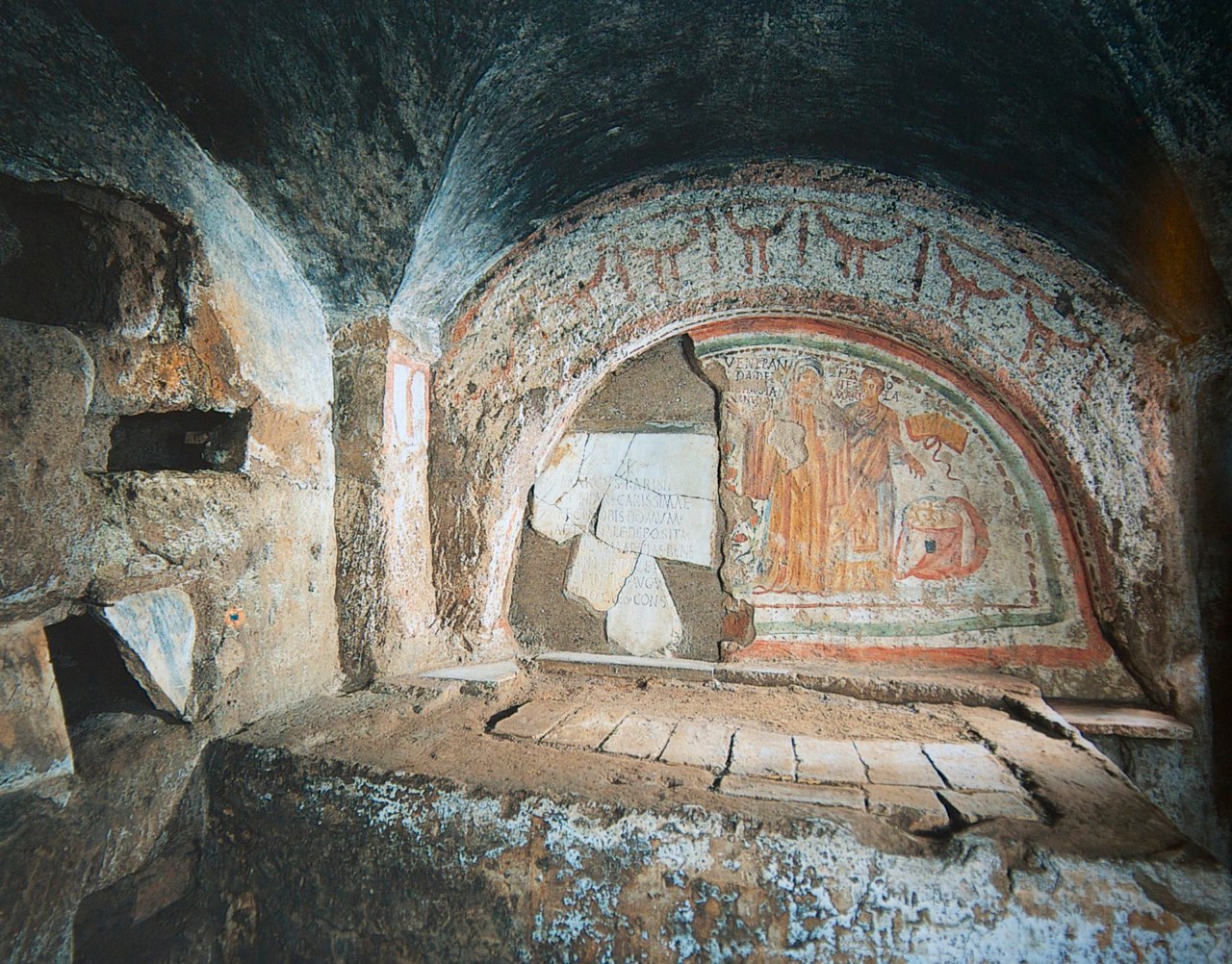
According to the 'Itineraries' the tomb of the famous martyr Petronilla lay behind the altar which covered the remains of Nereus and Achilles. The explorers were able to verify this indication. In a cubiculum behind the apse of the basilica, and approached by a short passage, a fresco was discovered on the wall filling the front part of the 'arcisolium' where the sarcophagus had lain; the painting showing two female figures standing, an elder and a younger woman with their names inscribed
Veneranda. Dep. VII. Idvs.
Ianvarias Petronilla Martyr.
in or close by this "cubiculum" was therefore, it may be safely inferred, the burial place of Petronilla. (The Church in Rome in the 1st. Century. London: 1913, p. 281)
When Siricius erected the Basilica of Nereus and Achilleus, he dedicated it not only to these two soldier martyrs but also to Petronilla. Who this Petronilla was suggests an enigma which is particularly difficult for the Roman Catholic Church to deal with. "There is nothing to go upon but a name, and learned doctors of divinity have dissected it to the bone, and the majority have found the root of the word 'Petros.' Who of that name would be so likely to be highly honoured as the daughter of Peter? Therefore it is assumed that he was her father." (The Rome of the Early Church, by Albert G. MacKinnon. London: 1933)
William McBirnie, in The Search for the 12 Apostles, states that "the apostle Peter had a daughter born in lawful wedlock, who accompanied him in his journey from the east."
This is echoed in Curiosities of Christian History, by Croake James: "In several churches at Florence and Rome the legend referred to was to this effect. The apostle Peter had a daughter named Petronilla, who accompanied him to Rome from the East." (London: 1892, p. 38)
The apocryphal Acts of SS. Nereus and Achilleus incorporates a letter attributed to Marcellus, son of the prefect of the city of Rome which states that Petronilla was the daughter of the apostle Peter and that she was buried on the estate of one Flavia Domitilla, on the road to Ardea -- a mile and a half from Rome.
 |
|
Burial Place of Petronilla in the Catacomb of St. Domitilla |
In a similar vein Ethel Ross Barker, in Rome of the Pilgrims and Martyrs, recounts the story of Auspicius, servant of Flavia Domitilla who brought the bodies of Nereus and Achilleus home by ship and "buried them in the property of Domitilla in the sand pits (Crypta Arenaria) on the Via Ardeatina, 1 mile and a half from the city, near the sepulchre in which was buried Petronilla, daughter of S. Peter." This information, the writer adds, "we obtained from Auspicius himself!" (London: 1913, p. 307)
William Cave, the eighteenth-century authority on the apostles of the Messiah, writes:
By her (Peter's wife) he is said to have had a daughter called Petronilla, (Metaphrastes adds a son) how truly I know not. This only is certain, that Clemens of Alexandria, reckons Peter for one of the apostles that was married and had children. (The Lives of the Apostles. Oxford: 1840, p. 215)
Strangely enough, the early English historian Bede, and the Anglo-Saxon Chronicles, make mention of Petronilla --
II. Kal. Jun. or the 31st May. This notice of St. Petronilla, whose name and existence seem scarcely to have been known to the Latin historians, we owe exclusively to the valuable MS. C. T. B. IV. Yet, if ever a female saint deserved to be commemorated as a conspicuous example of early piety and Christian zeal, it must be Petronilla. She was no less a person than the daughter of St. Peter himself...This is no Romish legend of modern growth, for her name appears in the Martyrology of Bede, and in the most venerable records of primitive Christianity. (Bede's Ecclesiastical History and the Anglo Saxon Chronicles, edited by J.A. Giles. London: 1903, footnote p. 455)
At a later date, the remains of Petronilla were taken from the Basilica of Nereus and Achilleus and buried in a circular chapel on the south side of old St. Peter's Church in the Vatican at Rome, but were removed in 1612 to a chapel near the east end of the present St. Peter's. Interestingly, "her sarcophagus was actually removed to the Vatican at the request of the King of France at a time when many such translations were made by Pope Paul I (755-756 A.D.)." (The Church in Rome in the 1st Century, p. 281)
F. G. Foakes-Jackson, in Peter: Prince of Apostles, makes another intriguing comment:
For some unknown reason Petronilla became the special patroness of the French, and, till recently, their ambassador, immediately after presenting his credentials to the Pope, invariably visited her shrine. (New York: 1927)
Petronilla in France and Britain
Now why would the English historian Bede, the Anglo-Saxon Chronicle, and a King of France take such an interest in this Petronilla? And why did Petronilla become the patroness of the French?
Because numerous traditions of Petronilla's presence in France and Britain linger to this very day! Taking this a step further -- since Petronilla evidently traveled with her famous father on his missionary journeys, then traditions of her being in various parts of the Roman Empire strongly imply Peter was with her! This being the case, let's see where we can find traces of Petronilla and therefore, by extension, of her father Peter.
A memory of Petronilla still lingers in the town of Petronell-Carnuntum, situated in Austria on the banks of the Danube River. The Roman town of Carnuntum was mentioned in 6 A.D. as "a place in the Celtic kingdom of Noricum" and, after the establishment of a permanent Roman military camp there in 40 A.D., Carnuntum became the capital of the province of Pannonia Superior. It soon became one of the most important towns north of the Alps -- situated on an intersection of the Amber Route and between the present-day towns of Bad Deutsch-Altenburg and Petronell-Carnuntum. At its height, Carnuntum had a population of 50,000.
A civilian city (Petronell-Carnuntum) grew up around the military camp from the middle of the 1st century A.D. onwards and, in this area, the traditions of Petronilla are strong. Found here is the Castle of Petronell and the Romanesque Church of Saint Petronilla.
Petronilla's and Peter's journey across Europe to Britain can be traced by the traditions found in old towns and cities lying astride the great Roman roads that dissected the empire. Across the channel in Britain, memories of Petronilla are particularly strong in the northeast, where church screens can be found in Bury St. Edmunds and Ipswich that depict the figure of Petronilla -- also known as Petronell or Pernel in Britain.
The first church dedicated to the memory of Peter's work in Britain was founded by King Lucius, a direct descendant of the valorous Arviragus. By royal decree, in Winchester (156 A.D.), King Lucius proclaimed Christianity to be the national faith of Britain. Writes Jowett --
The church was erected A.D. 179, to the affectionate memory of St. Peter, in commemoration of his evangelizing labours in Britain. It is still known as 'St. Peter's of Cornhill' and bears the legend on its age-worn walls relating the historic fact and dates by the order of King Lucius, the descendant of Arviragus, preserved to this day for all to see and read. (Drama of the Lost Disciples, p. 174)
The Hallowed Ground of Britain
Following the death and burial of Mary, the mother of the Messiah at Glastonbury, it became a fervent desire of holy men, pilgrims, kings, and other notables, to be buried within "the hallowed acres of Glastonbury." Here -- with Mary and the other apostles and disciples -- it is recorded that they "especially choose to await the day of resurrection."
There are many records still extant that support the claim that many of the Christian martyrs were brought to Britain for interment at Glastonbury -- and elsewhere in Britain.
Constantius of Lyons, who saved the city of Clermont in Auvergne, Gaul (France) from Euric the Goth in 473-492 A.D. writes, in his work Life of St. Germanus, how he took the remains of all the apostles and martyrs from Gaul to a special tomb at St. Albans in Britain.
But what of Peter and Paul? Are they still buried at Rome -- in the grave where the loving hands of Claudia, Pudens and their children had placed them?
Of Peter and Paul there is much confusion, mystery and outright misinformation concerning the site where their bodies found their last resting place.
The Roman Martyrologies tell us that Pudens (see 2 Timothy 4:21), after retrieving the body of Paul after his execution, buried it on their estate on the Via Ostiensa road. We also know, from the records of the Emperor Constantine, that he, aware of where the mutilated body of Paul lay, caused it to be disinterred. He placed it in a stone coffin, and over the spot built a church -- still known as St. Paul's Without-the-Walls, meaning the church and his body are outside the city walls of Rome.
When the original church perished, a larger one was built on the site. Fire destroyed this building in 1823. A new St. Paul's was built after the fire; and a Benedictine priest is continually on guard before a grill in the floor of the High Altar. Occasionally, for special visitors, the priest removes the grill and lowers a light through the floor into a cavity below, revealing a crude slab-stone on the floor bearing the name "Pauli." However, there is no stone casket to be seen.
What happened to it -- and to the body of Paul?
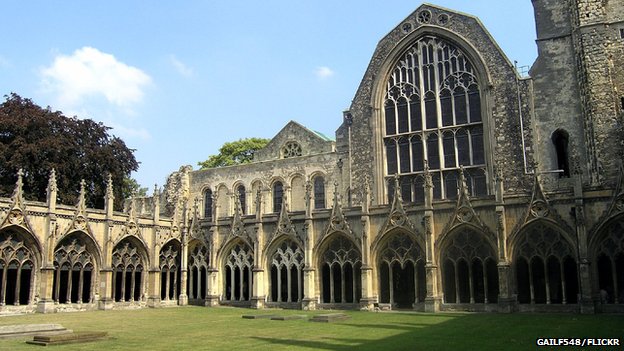
The answer to this question is found in a document written by Pope Vitalian to the British King Oswy in 656 A.D. The letter is still in existence. To the astonishment of many, the letter clearly states that Pope Vitalian permitted the remains of Peter and Paul, along with the remains of the martyrs Lawrence, John, Gregory and Pancras, to be removed from Rome and sent to England where they were reburied in the great church at Canterbury.
 |
|
Grounds of Canterbury Cathedral |
The full facts regarding this amazing incident are recorded by the Venerable Bede (673-735 A.D.) in his Ecclesiastical History of the English Nation:
In the year 656 Pope Vitalian decided the Catholic Church was not interested in the remains of the apostles Peter and Paul. The pope therefore ordered them sent to Oswy, King of Britain. Here is part of his letter to the British king:
However, we have ordered the blessed gifts of the holy martyrs, that is, the relics of the blessed apostles Peter and Paul, and of the holy martyrs Laurentius, John, and Paul, and Gregory, and Pancratius, to be delivered to the bearers of these our letters, to be by them delivered to you. (Bede's Ecclesiastical History, bk. III, ch. 29)
I was personally told by the librarian at Canterbury Cathedral (and I still have the letter) that the church inventories record the arrival of the remains of Peter and Paul to the church's safekeeping shortly after Pope Vitalian sent them to Britain. Unfortunately, though, it is believed the remains were lost, or record of their location lost, in the aftermath of the Cromwellian Rebellion.
The common belief was, and still is among the Roman Catholic laity, that the body of Paul rests beneath the high altar in the cathedral of his name. Similarly, it is also believed by most that Peter's body still rests beneath the high altar of St. Peter's in the Vatican. Nothing could be further from the truth! It is well known in high levels of the Catholic Church that for many centuries the cavities beneath the high altars of St. Peter's and St. Paul's have lain empty.
The American scholar and archaeologist Professor Kinnaman has written, in his book Diggers for Facts, the following reference to the remains of Paul --
The real earthly remains of the Apostle to the Gentiles sleep in the soil of England beyond the reach of the arm of the Roman law.
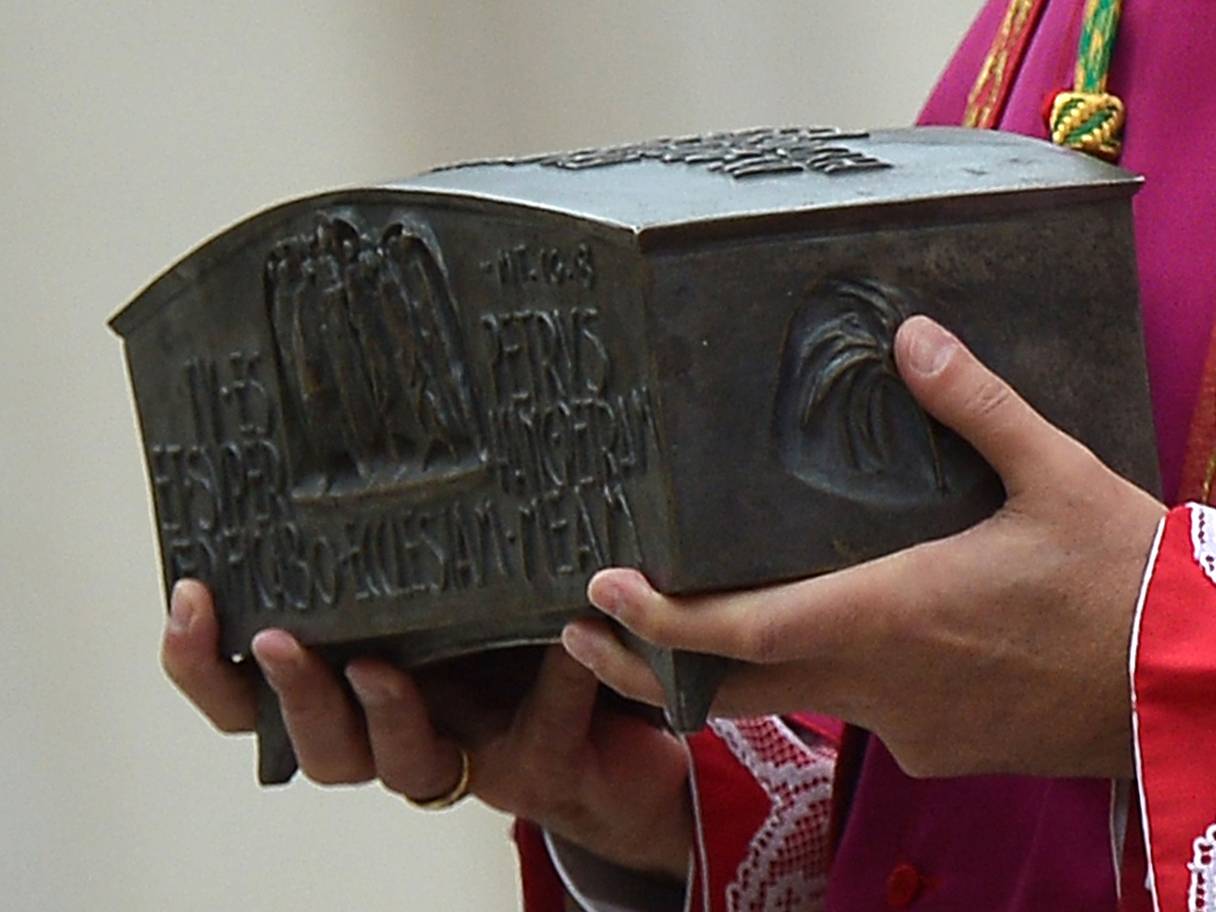 |
| Holding the bones of Simon Magus --
believed to be the bones of the apostle Peter by the Vatican. |
What of the empty tomb beneath the high altar of St. Peter's in the Vatican? The tomb once held the bones of Peter, that is true. But now, too, they lie buried with many other saints in England, described by historians as "the most hallowed ground on earth."
|
Hope of Israel Ministries -- Taking the Lead In the Search for Truth! |
|
Hope of Israel Ministries |
 |
Scan with your Smartphone for more information |